Sunday, November 23, 2014

Cooking

This month I'm using most of my allotted writing motivation in the pursuit of National Novel Writing Month. This is a challenge to write 50k words in a single month, which they classify as a novel. Coming into this month, I had no illusions about my ability to produce 50k words, but I wanted to make an effort. I tried this once back in 2010 and wrote 8k words of trash, so I decided to write at least 10k words. There's only a week left in the challenge, but I believe I will meet this goal by the end of the day if I stay focused, and I'm hoping that I might even double my former record by the end of the challenge.

Anyway, but this month I've been doing a lot of cooking because we recently purchased an oven for the flat. As much as I like cooking, it's a lot more difficult in a foreign country for several reasons.

  1. Motivation. My primary source of motivation at home is to feed my parents (and maybe my brother). When it's just me, even at home, I don't experiment and I tend to stick with meals that are quick and boring. And that's more or less what I do here as well, since I'm almost always cooking for myself.
  2. Ingredients. So first of all, the ingredients are in a different language. That's not really a problem as long as I remember to look up the Russian/Vietnamese/French word for any unusual ingredients before I leave home. Second, there are many things which seem to simply not be available, or are incredibly expensive. Quinoa for example, costs more than twice in Russia what it does in America, and it's expensive enough there. There are many spices I use regularly at home which I haven't seen here--one that comes to mind being Garam Masala.

    Furthermore, there are times when ingredients become completely unavailable. I used to use barbecue sauce about five times a week, but I haven't been able to find it in the stores for nearly a month. I might have mentioned this particularity before, but it still astounds me.
  3. Measurements. All my recipes have measurements in the English measurement system. Everything I buy is measured in the metric system. Again, not a problem, but frequently an annoyance.
  4. Cleaning. The last thing I want to do when I've been on a cooking spree is a bunch of cleaning. At home it's not so bad because I can usually rinse things off and put them in the dishwasher. Elsewhere, everything has to be washed by hand.
That's about all I wanted to say, so I'll get back to my other writing now.

Tuesday, October 21, 2014

You needn't be so kind as to throw snow in my face

Two days ago (October 20th) it snowed. Even the Russians were a bit surprised. I was walking to work, and I saw two children, probably brothers, enjoying the snow. The older one picked up a chunk of snow and tossed it directly into the face of the younger one. You can imagine what happened next. In English, there would be a scream of "STOP IT!" or "DON'T DO THAT". In Russian, though, they don't say anything like this. Instead, they say: "IT'S NOT NEEDED!" It's technically unclear what is not needed and for whom; this could mean anything from "I don't really need snow in my face" to "our parents don't need you to make trouble" or even "the universe does not need your assistance in creating chaos." I once asked an English teacher from Russia what I should tell my students when they're being mean to each other, and this same phrase was all she could suggest. I wasn't surprised when it proved ineffective--it seems far too vague and indirect.

So Russia has been in the news and most countries are looking on it as something like the Big Bad Wolf trying to blow down the straw house of Ukraine, or something like that. Most of my students don't really care to talk politics with me, perhaps because the US doesn't exactly have the best reputation either. One student did mention last night that the media is full of propaganda, and suggested that the Russians who are radical in their support of the violence in Ukraine are being misled by the media. But this student also said that most people were busy just trying to live a decent life, and for some this means just trying to survive. Regardless, the troubles haven't had any visible effect on my life, aside from causing a huge drop in my salary.

Saturday, September 20, 2014

Challenges in Living Abroad

When I discuss living abroad, people tend to think that it requires a lot of courage, especially one is not familiar with the language spoken in that area. I try to communicate that it's easier than you might expect, and everything quickly becomes routine. The real difficulty comes when you step out of the routine and have to do something dependent on actual conversation in the language.

On a regular basis, I hardly speak any Russian. The cashier at the supermarket asks me if I need a bag, and I say "I don't" (or, "yes, big please"). Then they ask me if I have a card, and I say no. Honestly, that's probably the only regular exchange in Russian that I have. Sometimes people will ask me for a cigarette ("no" covers that as well) or directions ("I don't know"). On the train, security sometimes asks for my ticket, and I don't even have to respond to that except to give it to them. So for ordinary situations, I use only four different phrases.

Speaking a language that you're not familiar with is uncomfortable and puts you at a disadvantage. In Vietnam it was always easy because if you had fair skin, people assumed that they would need to speak English. So in Vietnam, people were always accommodating me, and it was never very difficult or uncomfortable. In France and Russia of course, that's not the case, so you have two options. First, you could follow the example of my co-worker. Any time he is required to communicate with Russians, he proudly declares himself English (pointing to himself and saying Англииский) and from there either hopes that the other person knows some English or he gets along as best he can using gestures. I can't imagine doing this for a variety of reasons, so I use my broken Russian/French/whatever as best as I can until the result is satisfactory or one of us gives up in disgust.

So last week I had to do a couple of things that I dreaded because they involved actual Russian conversation. First I had to go to the national library of foreign literature to try to register for a Japanese test. I had no problem getting past security because I had practiced my introductory phrase ("I'm looking for the Japanese department"), and from there I was merely asked for my passport and then I was given directions. Arriving in the Japanese department, I had a lot more difficulty with the receptionist who was trying to instruct me on how to register. She said a couple words I wasn't familiar with, and I showed my foreign-ness by being at a loss as to how to ask her to clarify. She ended up speaking very slowly and loudly like I was a disobedient child, which was embarrassing. I got most of the information I needed though, and overall I felt good about the experience.

Later, I had to go to a photographer to get photos taken for the Japanese test. I was really hoping that I could just use some kind of machine, such as the ones seen in the film Amelie. But I didn't know where such a machine was, so I had to enter a small shop alone, the first time I've done such a thing in Russia. On the stairs in front of the shop there were three people smoking, and after I entered the shop I realized that they were the people who worked there, so I had just walked into a shop while the shopkeepers were outside. That was my first embarrassment.

I had no problem saying that I wanted passport photos, and the picture taking went smoothly. But then the photographer asked me if it was for a Russian passport and I realized that I could be making a mistake. He told me to check outside at the kinds of photos, so I was able to tell him the correct size. Unfortunately I told him using the wrong preposition (something like 3 along 4 instead of 3 by 4), but he understood. He had to tell me to sit down several times--I don't know why I didn't get the idea the first time. Eventually I got my photos though, and left feeling quite accomplished.

Sadly, I realized that there were still sections of the test application that I did not understand at all, and since these sections required my signature, I ended up deciding to forego turning in the application, and thus I missed the deadline. Ah well, maybe next year.

Thursday, September 4, 2014

Russia: The Next Generation

Or something like that.

So I arrived in Russia with very little incident. It was probably my least pleasant flying experience though for three reasons: I was getting sick, the flight meals were skimpy and unappetizing, and there was no way to watch films. This makes me sound spoiled. I suppose I am--this was the only overseas flight I've ever taken in which there was no TV. Eight hours is a long time to read a book (well, most books) and I like to take breaks with a film or two. Plus, it's the only time I really watch the latest films. So I was quite disappointed, and I recommend that anyone travelling overseas avoid United Airlines if possible, unless you've got several snacks packed and a really good plan for entertainment.

I don't usually talk to people while I'm travelling. One time I was reading a Japanese book and a Chinese couple sitting next to me noticed and asked me about it, and then we talked a little bit. I think that was pretty much the only time I've had a real conversation with fellow travelers. But this time, in the Geneva airport, a couple of my fellow travelers to Moscow struck up a conversation. The first was a Thai girl who worked in America but was traveling to see St. Basil's Cathedral because it was on her bucket list. She said that she went to Rio de Janeiro last month and saw Christ the Redeemer. I should have asked her what her job was.

A few minutes later a fellow American started talking to me--he was a Russian major studying abroad this semester in a smaller town. He had had a pretty crazy life, it sounded like, but he still seemed a bit intimidated by Russia. Also, he was arriving with no contact information, no idea of who would pick him up or at what time, and with only a calendar year of Russian under his command. I wanted to help him, but the line at security was enormous, and when I got out my taxi was waiting and she rushed me out the door. Hopefully he made it okay.

Every time I start a full-time job I wonder, “can I really do this? Can I really survive this way?” My first full-time job involved selling car parts. I decided very quickly that I couldn't survive that way. In France I survived, but I felt pretty terrible doing it. In Vietnam I was super nervous for the first few days, but somehow I eventually got to the point of enjoying it. It was pretty rough for my students, but they were used to worse I suppose. On my first day in Russia I had a complaint from my boss, and on the second day the students complained about me, so it was pretty rough. I made it through though because I didn't feel that either problem was really my fault.

Tuesday was my first time teaching in about seven weeks, and I was pretty nervous. This morning I unexpectedly had to make a trip to the central office in Moscow to pick up my textbooks, which left me only a couple of hours to prepare for six academic hours. Everything went swimmingly though, and once I started teaching I mostly knew what to do and never really felt nervous. But still I wonder—will I be plagued by doubt in my abilities for the rest of my life? Is this a condition especially prevalent in the field of teaching, and if I took another job would I be spared of it? I suppose there aren't many jobs where you have long breaks in the middle like this, so the reasonable answer would be yes. Thoughts?

Monday, July 14, 2014

Kvass

I love kvass--there's nothing better on a hot summer day. It's made with rye bread, and people say it tastes like liquid bread, but I don't really see that. It's carbonated, just slightly sweet with a bit of bitter earthiness. There's also a tad bit of alcohol, maybe 1% I think. Try some if you ever get the chance. You might not enjoy it, but the taste of normal (brown) kvass can't possibly be revolting. That's not true for all the varieties though.

Today I found black currant kvass and white kvass. The former was more sweet and sour than typical kvass, and overall I enjoyed it more but it didn't quite have the same effect. Then I tried the white kvass. At first I almost spit it out because it tasted sweet and bready at the same time, sort of like something that was rotten. But then after a second it was okay, and when I swallowed it gave a nice honey-like after taste. I had to go back for more. But (at least at first) it tastes like water and Cap'n Crunch cereal that was left together for days until all the cereal dissolved, and then it was slightly carbonated. Yeah, not appetizing (as I take another swig). But still tasty somehow.

Saturday, June 28, 2014

Cha-cha-cha-changes

As you can see, lately I can't be bothered to write. Anything. My workload has been reduced, but the the unpredictability of it is quite draining still. My boss tells me when I finish work on Friday to check the schedule (on the internet) before Monday. It's subject to change at any time. But on the whole I certainly have more free time. However, I use it differently than I did earlier.

Nowadays I'm more or less obsessed with history. I really enjoyed the one real history class that I took at college, but I didn't take it until my last semester so I had no opportunities to continue my study of the subject. Since then I've devoted a considerable amount of time to studying languages, and thus I have mostly felt obligated to devote the majority of my reading time to literature in a foreign language. In April of this year, though, I thought that I was going to go to Istanbul, and so I felt obligated to read up on the history of this city which looms so large in history. The book I read opened a whole world to me; perhaps it changed my life in a significant way.

So recently I've read a lot of history books, and I've also been playing a game which is kind of an alternative history game. Starting at any date in history between 1397 and 1820, you take control of any of the countries that existed during that time and alter its fate. You make your own goals to change the course of history--you could make Japan a colonial power, unite the entire Iberian peninsula in one country, keep the Byzantine empire from succumbing to the Ottoman Turks, or simply make your country of choice become an important trading hub. This is really interesting to me, and I tell stories to myself about it even outside the game, so perhaps that's satisfying my writing urges.

In (more) real life, I moved to a new flat, which for the most part has been a good thing. I've also been doing a lot more social activities. I went to a company picnic, bought some roller skates and have used them many times, visited some churches and parks in Moscow, and in general I take a lot of walks in the evening.

The weather here has been crazy. On May 7th it snowed a good bit. Five days later (I was still in my old flat at this time), the hot water was shut off. Apparently they do this every year in the summer, so I was sort of expecting it, but I was shocked that it would happen less than a week after a serious freeze. Also, this water isn't just cold--it's painful and numbingly icy, to the point where you can't keep your hands under it for more than ten seconds or so. I don't mind cool showers, but taking a shower in water of this temperature was nearly impossible. Basically I used the water that had warmed up a little from being closer to the tap, and then when it reached a stable temperature I turned it off. Fortunately it wasn't very hot that week, so I never became very sweaty.

Soon after I moved into my new flat, the temperature became extremely warm--in the nineties for most of one week. This was horrible on the train where there is almost no ventilation. Sometimes a young man will hold the doors of the train open--back to one door, foot pushing against the other door, and balancing on the other foot, with nothing to keep him from falling out except good balance. It's a remarkable sight which I'd like to take a picture of, but I feel very uncomfortable photographing strangers.

During this time I kept my window open like I did at the other flat, but this allowed mosquitoes to proliferate in my bedroom. After a few days my feet, arms, and even my face were covered with mosquito bites and I decided that I was more likely at this point to die of blood loss than of suffocation. So, I closed the window and went on a crusade against the mosquitoes, killing at least fifteen of them. It seemed strange to me that the mosquitoes were so bad, despite the fact that I was on the fourth floor of a flat in the center of a decent-sized city.

Shortly after that the weather became more temperate, and then the hot water was again turned off for a week. I figured that pretty soon I would become able to take only cold showers, and actually I did enjoy them somewhat. When you finish, everything feels like it has just come out of the dryer, so that's a plus.

Alright, I have two and a half weeks left in Russia, then I'm coming home for six weeks. My goal will be to write one more entry before I leave.

Friday, May 2, 2014

A New Bryant Weather System

I guess because my grandfather grew up on a farm, the weather often comes up when talking with him (or my dad, or my uncles). I think the influence of weather has more or less died out with my generation, but at the moment it's rather important for me because I'm quite susceptible to the elements, not having a car.

As you should know I had the privilege of sharing my flat with some rodents for the first 5.5 months of my life in Russia. The rats can no longer enter my flat, but nevertheless their existence continues to benefit me in an unexpected way. You see, when the flat was sealed, a considerable amount of poison was put into the rats' hole beforehand. About two weeks ago the weather became quite warm, and thus I became aware of corpse(s) belonging to one or more of them, and which sit directly below the floor of the entrance hall of my flat. In a few days I discovered that I could use the strength of the odor to determine the approximate temperature outside, and thereby make reasonable wardrobe selections. If I wasn't able to smell the rat at all, a coat was essential. If I smelled the rat in the hall, then I could probably get away with a sweater and no coat. If I could smell the rat from my bed, it was a day for short-sleeves or rolled-up long sleeves. Of course it would be much easier to discern the weather from some electronic device, but I feel that monitoring natural phenomena with electronics reduces the reality of life somehow. And hey, here I've got a pretty natural system so why not use it.

Saturday, April 12, 2014

Stereotypes and Russian Sociality

Russians are well aware of stereotypes about them. They mention the balalaika, dancing bears, and vodka (as well as being rude, which I think I mentioned before). But they deny these stereotypes for the most part. Vodka is a pretty accepted part of the culture, but to be honest I've never seen a Russian man drinking vodka in the 6+ months that I've spent here. In public they often drink beer and some strange canned drink with a powerfully sweet and disgusting watermelon smell. In restaurants I've also seen them drink whiskey and wine. But maybe I just don't hang out in the right places to see vodka consumption, which is quite likely.

My neighbor, with whom I now talk regularly, mentioned these stereotypes and said that Russian people are just ordinary. They work and they like to relax and they try to live. And that's all.

I think I have a better grasp on why Russians are rude. They seem to have very little regard for lack of acquaintance. They'll ask anyone for directions or information. I once asked a student to imagine that she wanted to go to a restaurant but didn't know where it was. I asked what she would do. I, of course, would look up the place on the internet, but the student said that she would start going in the direction she thought it was, and then ask for directions along the way. Continuing with my point, most ladies seem to feel completely entitled to tell anyone what to do. On the bus or train, they'll say "Why are you standing? Sit down here." One day my landlady came to my house and the door happened to be open, so my neighbor just walked into my flat.

This would seem unpleasant for most Americans, but there's another side of the coin. Russians are also very friendly and open to hospitality. I mentioned in my last post about how I used to just ignore my neighbors but they talked to me and invited me to visit them if I ever needed anything. Well, my other neighbor (the one who unceremoniously walked into my flat) also offered to help me if I ever needed anything, and she told me to call her grandma (babushka). The administrator at Butovo often feeds me dinner because I work from 3:30-8:00 and then I have an hour+ trip to home. I've been invited to dachas and to dinner. I can't remember all the examples of hospitality, but I definitely feel that it is here in abundance.

So that's nice, but it's also very stressful for me. It's most comfortable for me to keep most of my life private and be in control of when someone can come in and change it. In Russia, I feel that I can't maintain this control, because people are used to being involved in everyone else's life. Another example--here it is rather strange for grandparents not to live with their children and grandchildren. The grandmother usually take care of the children while the parents are at work. I think this is a very reasonable system and I admire it, but once again it reduces privacy.

Aside from some altercations with my landlady and the administrators, nothing too exciting has happened lately. I've been here for 6 months, and my last day of work should be three months to the day from today. I should have a better idea of my future plans in the next couple of weeks.

Monday, March 3, 2014

The Russian Roller Coaster

Teaching is a roller coaster--I think most any teacher would tell you that. In addition to the normal ups and downs of teaching, I've also experienced quite a few ups and downs from just living in Russia.

You already know about the rat, but there was also a problem with my neighbors about a month ago. Well, it wasn't really a problem, but it traumatized me a bit. You see, when I hear the door bell I don't answer it--first because I'm not sure that it's for me (I share a hall with two other flats), second because I'd prefer to act like I'm asleep or not at home to having to meet a new person, and third because it's not likely I would understand them in the first place. My Russian comprehension is pretty decent when I have some context, but without context I'm not very good, and being nervous/under pressure also considerably drops my abilities, so a combination of the two typically results in gibberish.

Anyway, the problem was that the flat below mine had noticed their ceiling being damp and had come to investigate. They rang the doorbell many times until one of my neighbors answered, and then they banged on my door. When I opened it, a large man and woman walked into my house without much ceremony (taking shoes off though, of course) and proceeded to inspect my kitchen for a leak. While they were entering though, the elderly lady who lives on my hall scolded me for something. I'm not sure what it was, as all that I understood was "Didn't your mother teach you to..." I might have tried to understand, but I felt obligated to accompany the intruders and the elderly lady seemed satisfied with her scolding and so went back into her flat. No leak was found, but this experience made me even more reluctant to answer the door, and for a while I always checked the hall through the peephole before I left, out of fear that I would run into someone and receive another scolding. Yes, I'm a coward.

Well, I passed my other neighbors on the stairs one day (which happens about once a week as the man often stands in the stairwell to smoke). The man called my name and we had a chat in Russian and English. Basically they told me that they were happy to have me there, and told me to stop by to talk sometime, asked me about the rats,  and explained that I needed to wash the floor in front of my flat (which I suspect was what the elderly lady had scolded me for). I haven't stopped by yet, but I'm not as reluctant to encounter my neighbors anymore.

This same week I was walking to work and at a stoplight, a man asked me for the time. I showed him my watch because I knew that would be the easiest thing, but he told me he couldn't see well. I tried to remember the word for 12 (which is one of the banes of my Russian language existence--the similarity between 12, 9, and 19) but I couldn't, so I told him that I was sorry but I was a foreigner. He asked where I was from, and then as we split on the other side of the street he told me to give his regards to America.

I dropped something off at work and then continued to the train station when I met the man again. I walked with him for about 15 minutes and he talked to me in Russian the whole time. I only understood the gist of what he was saying, but among a few topics he talked about how strange it was that men could love a woman for one night and then never see her again. I felt like I had met a character from a Dostoevsky novel (General Ivolgin, to be precise, though this man wasn't as crazy as that).

That Friday was quite rough--one of the students in my morning class kept repeating that she was bored and she kept being mean to a new student (who is far below the English level of the others, but that's no reason to treat him inhumanely of course). My next class was with my youngest students, one of whom wet herself and the floor in the first 10 minutes of class and I had to teach the rest of the class walking around in the mess. I was extremely glad when that day was over.

However, the next day when I woke up and went to the toilet, I discovered that there was a rat trapped in it. Rats have been in my toilet before, I know because I've heard them and seen the residue. This one was a smaller rat though, because it couldn't get out. It was a pathetic sight, splashing around with completely soaked fur, and I've decided that getting stuck in a giant toilet would be among the worst ways to die. Deliberating on what to do, I finally decided that the most humane action would be to drown it. That was rough, and even though the rats have caused me a lot of grief I still cried a bit over it. Then I flushed him down the toilet. But an hour later I heard rats in the kitchen, so clearly he wasn't the only one.

Shortly thereafter, I discovered that my kitchen sink had a leak. When I discovered this, the water washed a lot of the rat residue from under the counters out onto the kitchen floor, and it was absolutely disgusting and the kitchen still stinks of it. Furthermore, having no kitchen sink is a pain, as I discovered. I had to wash my dishes in the shower for a week, which wasn't fun. Fortunately I got sick the next day and couldn't eat much, so I didn't have many dishes to wash that week.

Hmm, I probably should have told that in reverse order. Oh well, those are some of my most recent ups and downs. The holes in the walls and floor have been patched and I haven't seen my rats recently, so that's probably fixed. The kitchen sink is usable again. But even so, I'm tired of living in Podolsk, and I'm going to try to get a new situation as soon as possible. I'll find out more about it tomorrow, I hope.

Sunday, February 9, 2014

More observations about Russia

Well, it's another year. My schedule is a little crazier, and likely to get crazier still. I'm not happy about it, but I think that if I wait it out I'll be able to have a much nicer position for the next contract. Only 5 months left! (That seems really long at the moment though). I'm doing better since the new year because I've made some solid, achievable goals and I'm working on achieving them every day.

Nothing particularly exciting has happened in the past month. The rats are still alive despite a visit from the exterminators. I learned that rats can climb walls, which explains how they've managed to get on my kitchen table. My rats also particularly enjoy collecting plastic and stuffing it into their hole. It's kind of interesting to see what they will do next, but there are plenty of drawbacks too so I would prefer to have them gone.

I learned recently that some Russians face a lot of difficulty with finding an employer who honors their contract terms. Apparently lawsuits are often rendered ineffective through bribes. Also, one of my coworkers had to stay in the hospital for a few days and he said it was awful. So as far as living in Russia goes... unless there's a miracle, I think I'd rather not stick around too long.

On the other hand there are some really admirable things that I've discovered about Russians as well. Although they don't go to the theater to see plays every week like my Russian language courses suggest, they are much more cultured in general than Americans. The students are required to memorize poetry from an early age and they seem to retain the memory of this poetry. When I do speaking tests for prospective students, I often ask the question “Do you like to read?” I've yet to hear anyone say no to this question, and what they enjoy reading varies considerably.

The roads are packed and inefficient, but the public transportation here is excellent. The trains are frequent and usually within two minutes of their target time. Buses are less punctual, but are rather ubiquitous. And people here like to walk. When I asked my teenage students what they did during the new year holidays, almost all of them said that they ate, slept, and walked with friends. Imagine a teenager in the US saying that they spent time “walking with friends.” You'd probably assume that they were Amish!

And that's all I have to say about Russia for today.

Wednesday, January 15, 2014

Wishy-washy

I often wonder if most people have as much trouble as I do sticking to one thing. My plans and hobbies constantly change. Generally when I have some accountability, I can see something through to the end, if it's not too long. But a list of the things that I have done to completion would be quite short. So far I have finished two work contracts, and to be honest, while I enjoyed both jobs, it felt like a heroic effort to make it to the end.

I have had even more second-guesses about my career choices since I came to Russia. I've been here three and a half months, and about once a week I decide that I'm never going to teach again after this year. I would go back home and work one of those 29-hour week jobs (that are probably in good supply now) while going to school to study computer science. This would lead to a stable job with a salary decent enough to support a family. My job would involve less contact with people and I would be doing work that focused on problem-solving instead of directing and performing. It sounds really nice, although I'm probably idealizing it.

But then I think about living in the US and not being able to meet interesting or different people and rarely if ever experiencing new cultures again. I think of the solitude of life in the US, of having to drive to work every day, of being bombarded with extravagance and yet feeling that it's normal and necessary. What if I never live in Japan, if I never live in the Middle East... would life still be fulfilling?

Tonight I felt very fulfilled after work. I thought about my schedule and realized that aside from my new high-pressure business class, I really like all of my classes. Anyway, I bought a digital piano for Christmas, which I consider to be the signing of a second contract (as long as it is offered to me). Furthermore, there's no way I can learn Russian to a satisfactory level in the next 6 months, and I think that is one goal that I will maintain for a long time, since I think it is the most beautiful language.

Speaking of languages... (Uh oh, he said the l-word, that means it's time for a LANGUAGE RANT)

I last updated my language goals over a year ago, but only to add one more language to the twelve that two years ago I decided to learn. I'm reconsidering my goals now, perhaps because I'm at a low point in my language studying. I love languages--there's no doubt about that. However, I've discovered over the past two years that my passion (or perhaps my discipline, or both) isn't strong enough to sustain my goals, especially when there are so many other things I want to delve into (for example, fantasy cartography). I have put a good bit of effort in learning several of these languages, so I have a better idea of what I really want now. Also, I think that one reason I study languages is to be more proud of myself, to impress more people, and the more languages the more impressed they'll be. Obviously this is a poor reason. So I've decided to re-evaluate my goals again in attempt to be more realistic.

Russian - I think if there's any language that I'm determined to learn to near fluency, both speaking and reading, it's Russian. It never ceases to enchant me, even though I've heard it so often in the past months. And yet I've made very little effort to improve it while I've been here. Something needs to change, but I'm still deciding what that is.

French - I'm happy with where I am in French, although I would like to expose myself to it a little more often. I think I should try to set a very moderate goal of reading three novels or so in a year and watching the news once a week, just to make sure I don't regress much. I'm considering going back to France for a visit, perhaps even this year, so if I do that I'll work harder at it.

Japanese - as I mentioned, I still intend to go to Japan someday, and I've got a long way to go in the language. Unlike with the other languages, I haven't encountered any Japanese literature that has enchanted me--I learn it purely for the language mechanics, so I'll be happy if I can read newspapers slowly and converse haltingly. Even so, I need to set a goal with Japanese which is more strenuous than with French--maybe 20 minutes a day or so.

Arabic - I don't know why, but I feel strongly drawn to Islamic culture. The Arabic language is central to this culture. So I intend to learn Arabic someday. For now I have no goals, but if I can establish a routine for my other languages maybe I'll consider it. I do know that it will take years for me to just get accustomed to it, so the sooner I start exposing myself to it, the better. A year ago I could read Arabic (with the vowel marks) almost as well as Russian, but I've barely studied it at all since then.

German - People say that German is an ugly language. For me hearing it conjures up images of the Nibelungenlied, Beowulf, and Tolkien. When I studied it every day, I considered it the most fun of all the languages. I don't have any immediate motivation to study, but I definitely want to improve my German significantly one day. Incidentally, I think if I could move anywhere else in Europe, it would be Germany.

Spanish - it's a useful and accessible language, and lovely to sing. I like speaking it almost as much as German. For the moment I have little reason to learn it, but I think if I decided to do so then I could pick it up fairly quickly. So I'm still on the fence about whether I should remove this from my list of languages.

Latin - it's fun, but I will never speak it fluently, and when I tried to read some literature I decided that it wasn't interesting enough to really put a lot of time into. This will probably be a hobby language--one that I pick up when I really want to study something else.

Italian - I wanted to learn this for the sake of some operas and some medieval/renaissance literature. One of my coworkers has spoken some Italian, and I've decided that I don't have much interest in learning it after all. The medieval/renaissance literature is hardly riveting, and though the opera is a bit of a loss I think I can find other, less time-consuming ways of understanding it.

Chinese - I tried studying Chinese. Not much, but enough to find it frustrating and boring. I like to hear some people speaking it, and I think it would be extremely profitable to understand and speak myself, but I don't think these will happen.

Greek and Hebrew - obviously I wanted to learn these to be able to read the Bible. Unless I decide to go to seminary, these are not very relevant to me. They might be good study-for-fun languages, but I no longer intend to achieve literacy.

Persian and Sanskrit - okay, to be honest, I picked these out more because they sounded interesting and important. I've not put any effort whatsoever into learning them. Once again, I might study them for fun, but unless I end up going to Iran I'm not going to put much effort into Persian, and it was pure ambiance that inspired me to learn Sanskrit (although some of the writing styles are so cool!)

So this still leaves me with five or six foreign languages to study, which is a lot, but my French doesn't require much more effort and I have a solid start on the others (except Arabic).

Wednesday, January 8, 2014

My 2013 daily routine in Russia

My schedule in Russia has been considerably more volatile than in Vietnam, but I still managed to establish something of a routine. I work Monday through Friday and sometimes on Saturday. Typically I get up between 9:30 and 10, less than an hour after the sun has risen. I plan my day and make any preparations necessary for work, do laundry, and maybe some cleaning. My typical menus only require about fifteen minutes to cook, so I usually begin lunch at 11:45 and I've finished eating by 12:20.

On Monday and Friday I have to go to Butovo, so I leave my flat at 12:35, walk to the train station, and catch the 1:08 train. I arrive in Butovo about 1:22 and run from the train station to the bus station, barely in time to buy tickets before the 1:28 bus drives up (it's almost always early). The bus ride to the school takes 20 minutes, which gives me an hour and forty-five minutes to plan for my classes. I don't typically need that much time, so I spend at least fifteen minutes chatting with the administrator there. Typically I learn some Russian and she learns some English. I then teach from 3:30 until 6:15. Both my classes in Butovo have three students, and they're all nice and easy to teach. On Monday I have to hurry back to Podolsk to teach an adult beginner class starting at 8.  On Friday I stay in Butovo a little longer and teach a teenage student one-to-one for 45 minutes.

The other weekdays I stay in Podolsk. On Tuesday and Thursday I start teaching at four, so I typically leave my flat at 1:30 and arrive at the school at 1:50, then plan for two hours. I teach a nice small class of intermediate teenagers, and then a crazy class of younger students. On Tuesdays I also teach an adult pre-intermediate class, so I get home just after 10 PM. On Thursdays I get home early--around 8 PM unless I do shopping first, which is what normally happens. As for Wednesdays, I don't think I've had more than two with the same schedule.

After work I might go shopping if the shops are still open. My free time has been a strange thing here in Russia. I do a little bit of Russian studying, but not a significant amount. On the bus and train I do a lot of flashcards, and I talk to the administrator at Butovo, but I'd say that outside of those things I spend less than two hours on Russian every week. Grocery shopping happens at least three times a week, so some time does go into that, but only one of those trips takes more than twenty minutes. I waste some time on the internet and on video games, but I can't recall obsessing over any game. I know that I've spent many hours programming a game for my students, but I still don't feel that it accounts for all the time I'm missing.

On the third Saturday of the month all the teachers have to go to Moscow for professional development seminars. This has ended up being a full day trip every time so far. Two Saturdays I've had other working responsibilities, and on one Sunday as well. I've visited Moscow on a few of these weekends for sight-seeing or excursions. Most weekends I go on a big shopping trip.

Life feels a lot busier than it ever has before, but I can't completely account for this feeling. Apparently a lot of things will change with the new year, so maybe this will be one of them. My goals for the new year are to work harder on Russian, meaning getting a teacher if necessary, and to spend a fair amount of time on the piano every day (this was my Christmas present to myself, with the help of some folks back home). I also hope that I'll write more and do better with correspondence, but I think this has been my goal every year, so I'm not expecting a whole lot.

Sunday, January 5, 2014

Russian food and the dacha way of life

At long last I've arrived at the new year holidays. I've enjoyed them quite a bit, mostly spending them by practicing piano and reading. The first few days were more interesting though, because I went to a Russian dacha, a country house.

The dacha was located about a thirty-forty minute drive from Podolsk, within an entire suburb of dachas. I would say that dachas most similar to lake houses in America--out in the country down very narrow roads, and not typically the most elegant buildings. The house itself wasn't extremely comfortable, which makes sense considering most dachas are built by their owners. In fact the second story of the dacha had a lot of unstained wood and signs of ongoing construction. The stairs were very narrow and steep. The insulation seemed to be missing or not very effective--most of the time we had the heaters going full blast, but it was still cool near the floor and near the walls. It was an interesting experience to feel warm standing up and then become cool by sitting on the floor--kind of like swimming in a lake.

When we first arrived there I sat down to peel onions. Between me and one other person, we peeled nearly 10 kilos (22 pounds) of onions that day (but I'll admit that he did most of it, having arrived earlier). I didn't do much more after finishing that except wait for preparations to be completed. After we had been there for two hours or so an interesting dilemma cropped up. We had three enormous containers of salad made (to be explained later), but these salads needed mayonnaise, of which we were in short supply. A poll went round concerning who was able to drive--in the final analysis there were only three people, all of whom had had several beers and were continuing to drink in an effort to find a solution. For about an hour and half while we were hoping for dinner all I heard about was how we had no mayonnaise and no one could go to the store to get it, as walking was about four cold and windy miles each way  and by this time it was dark as well.

We finally sat down to eat at ten minutes to midnight and the new year. The mayonnaise problem was temporarily solved by only adding mayonnaise to the salad that was on the table. The TV was on and was displaying the clock tower at the Kremlin, as is traditional. At midnight, after the clock tower had tolled twelve times, the host opened a couple bottles of champagne and filled our glasses and we toasted to the new year. Then we listened to Putin's speech while eating dinner. After dinner we didn't do much--mostly we watched the horrific musical performances on TV from the new year's celebration until about five. I slept in a fold out armchair which was barely more than fabric covered wood, but I managed to sleep well enough.

I found my time at the dacha to be very strenuous for a few reasons. First, the host had joked that the dacha "way of life" (быт in Russian) is to wake up, eat, drink, and sleep. Indeed, people didn't seem to be very interested in doing much else, which was frustrating to me. I did get a lot of Russian practice in though, and I visited a memorial to Russian soldiers from several different wars. Second, I hadn't had any information about the trip except that I should bring something to drink. I assumed that we would stay the night, but hoped that we would leave in the afternoon of the next day. It was 9 PM of the third day before we left, and I was grossly under-prepared for such a significant time investment. Also, I felt very unclean, because of the third problem: no running water in the dacha. There was a well, and people filled up buckets and brought them into the house, and that's what we used for hand washing and the little dish-washing that we did. Most of the time though, the serving dishes just stayed on the table and were refilled when necessary.

Well, that covers the majority of my time at the dacha. Now something I've been meaning to talk about for a long time: Russian food. I've asked a few of my adult classes for some recommendations about Russian food, but they've all been unsure of what Russian food is exactly. From what I've seen so far, the most distinctive dishes are salads and soups.

Salads aren't typically the kind with lettuce (from what I understand that's specifically a caesar salad or a greek salad). These salads are chicken or ham or potato salad, but they have a lot more than just a couple of ingredients. One of my favorite salads, Olivye, typically has potatoes, ham, peas, pickles, and possibly other vegetables. Chicken salads vary, but I've yet to have one that wasn't delicious. And there are some wonderful mushroom salads. To be honest, there are very few salads I've had that aren't tasty. Most of my experience with salads comes from buying them in the supermarket, so probably when they're homemade they're all tasty.
A typical olivye salad

If there is a Russian national dish, it's probably borsch, beetroot soup. This is a slightly sour soup with or without meat but always with a beautiful purplish-red color.

Borsch is a nice, hearty and pleasant dish. I don't crave it, but I'm always glad when I've eaten it. Solyanka is a soup that's tastier when I've had it, but apparently there are so many different variations that it's hard to say what exactly is in it. Those are the only soups that I've had, but there are many more apparently, including milk soup.
No joke. Milk with noodles.

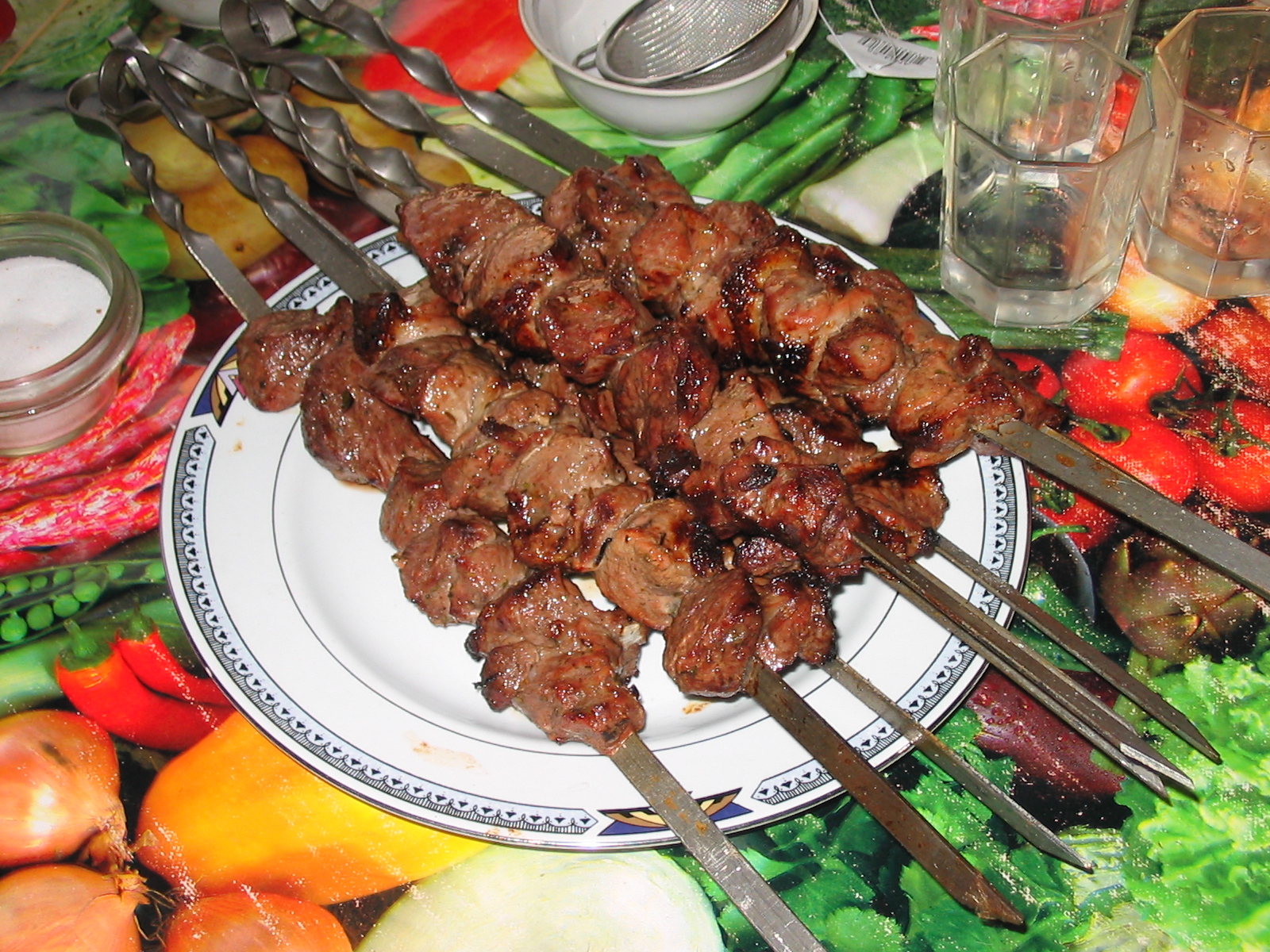
Outside of these two important types of dishes, Russians also seem to eat a lot of bread and sausage. Buckwheat is at least as popular as rice. Caviar is fairly common as well, and I've decided that I'm not a big fan of it. Another famous Russian dish (though apparently more Caucasian than Russian) is shashlik, barbecued fatty meat. I had had it three times before going to the dacha, but only at the dacha did I enjoy it. Wow, it was good.

Our shashlik looked exactly like this.

In terms of fruits and vegetables, Russia is disappointingly similar to America (in comparison with Vietnam). Apples, pears, oranges, bananas, and grapes are all staple fruits. However, cherries are more plentiful, and there are two kinds with completely different words. Apparently during cherry season they become extremely cheap. They also have blackcurrants, which is a wonderful thing because I love blackcurrants. My boss gave me a large jar of her homemade blackcurrant preserves which I would love to tear into, but I haven't figured out how to open the jar yet. Also, orange peppers are quite a bit more common and cheaper here, much as green peppers are in the states. That's nice for me because I enjoy them quite a bit more.

I'll probably have more to say about Russian food in the future, but that's all for now!